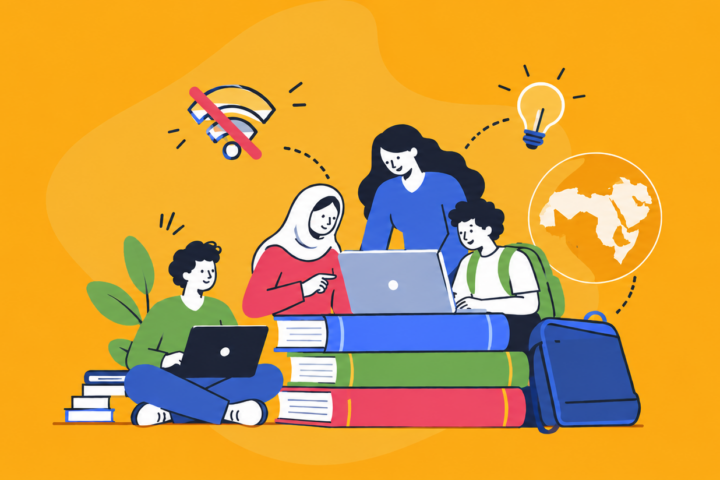
At Edraak, we believe that every student deserves access to world-class skill development, delivered in the Arabic language they use every day. Yet for millions of students and educators across the Arab world, poor internet connectivity and a lack of digital devices remain formidable barriers to learning. Through our partnership with Thaki—an organization that provides laptops pre-loaded with rich, offline-accessible educational content—Edraak’s courses have reached the classrooms that need them most.
In 2025, this partnership expanded access to learning across Egypt, Lebanon, Jordan, Syria, and Palestine. By distributing 998 laptops to 47 schools and learning centers, the initiative reached an estimated 16,866 students, equipping them with essential digital learning tools.
Beyond the Numbers: Real Results in the Classroom
While the metrics are compelling, the true measure of success lies in the changes taking place inside these classrooms. Based on feedback from 342 students and 74 teachers, offline digital learning is actively transforming how students engage and achieve. Educators observed greater student participation, while students reported meaningful improvements in both their academic performance and overall learning experiences.
Students also reported that Thaki devices helped develop their digital skills and strengthen their understanding of core subjects. The majority reported improvements in their language skills, including English (92.3%), Arabic (83.7%), and French (61.0%). They also reported improved understanding of mathematics (82.0%) and science (83.4%).
For educators, Edraak content was not simply an additional digital resource, but an effective educational tool that supported their teaching practices. 94.6% of teachers found Edraak content effective in providing additional resources to enrich their teaching, while 93.2% found it effective in supporting lesson preparation.
These findings reinforce our belief at Edraak that when technology is thoughtfully leveraged and supported through institutional collaboration, it can help overcome geographical barriers, expand access to high-quality educational resources, and open new possibilities for learning for students wherever they are.